
Why More and More People Are Calling Cape Paterson Home
Six beaches, a rock pool built by coal miners, and one very good pub. Why Melbourne families are quietly moving to Cape Paterson
There is a particular Wednesday evening that a lot of Melbourne households will recognise.
It is ten past six. You are somewhere on the Monash, between Warrigal Road and the tunnel, and you have moved four car lengths in as many minutes. The radio has looped the same traffic report twice. Dinner is a question mark. The kids have already eaten. Somebody at work sent a message that can wait until tomorrow, and you will answer it tonight anyway. You have done this drive so many times that you no longer notice the buildings, only the brake lights.
At some point in that queue, a thought arrives that is not really about traffic at all. It is the thought that this is not a season you are passing through. This is the arrangement. And unless something changes, it is the arrangement for the next twenty years.
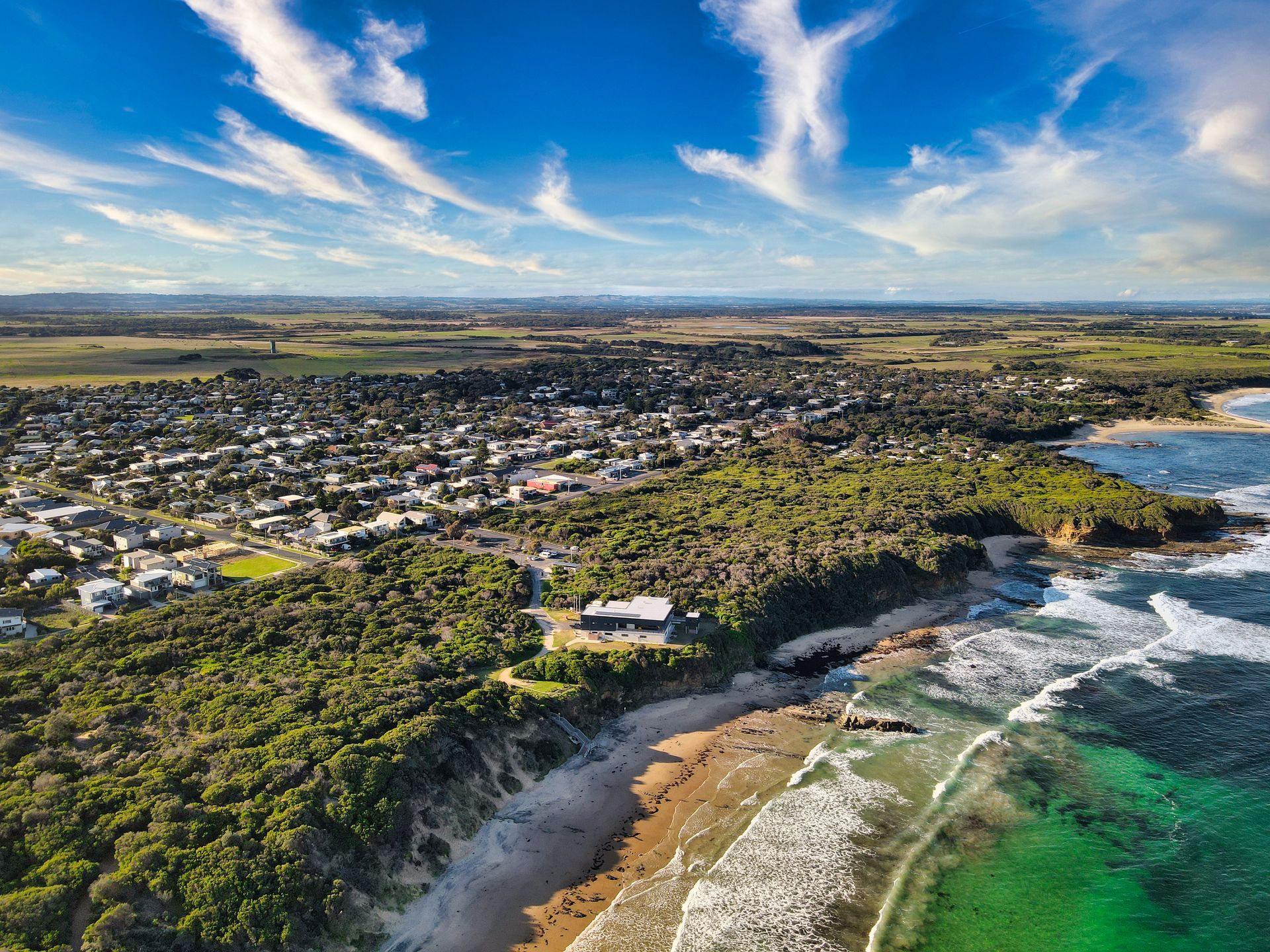
That thought is why an increasing number of people are turning off the highway at Wonthaggi and driving the last eight kilometres south to a small seaside town with six beaches, a rock pool built by coal miners, one very good pub, and a coastline that looks much the same today as it did when their parents first swam here.
The morning that changes everything
The first thing you notice at Cape Paterson is what you cannot hear.
There is no distant hum of arterial road. No sirens. In the early morning the loudest sound is the surf working away at the rock platform below the cliffs, and the birds arguing in the tea tree. It is the sort of quiet that takes a few weeks to get used to, because for the first fortnight you keep waiting for it to be interrupted.
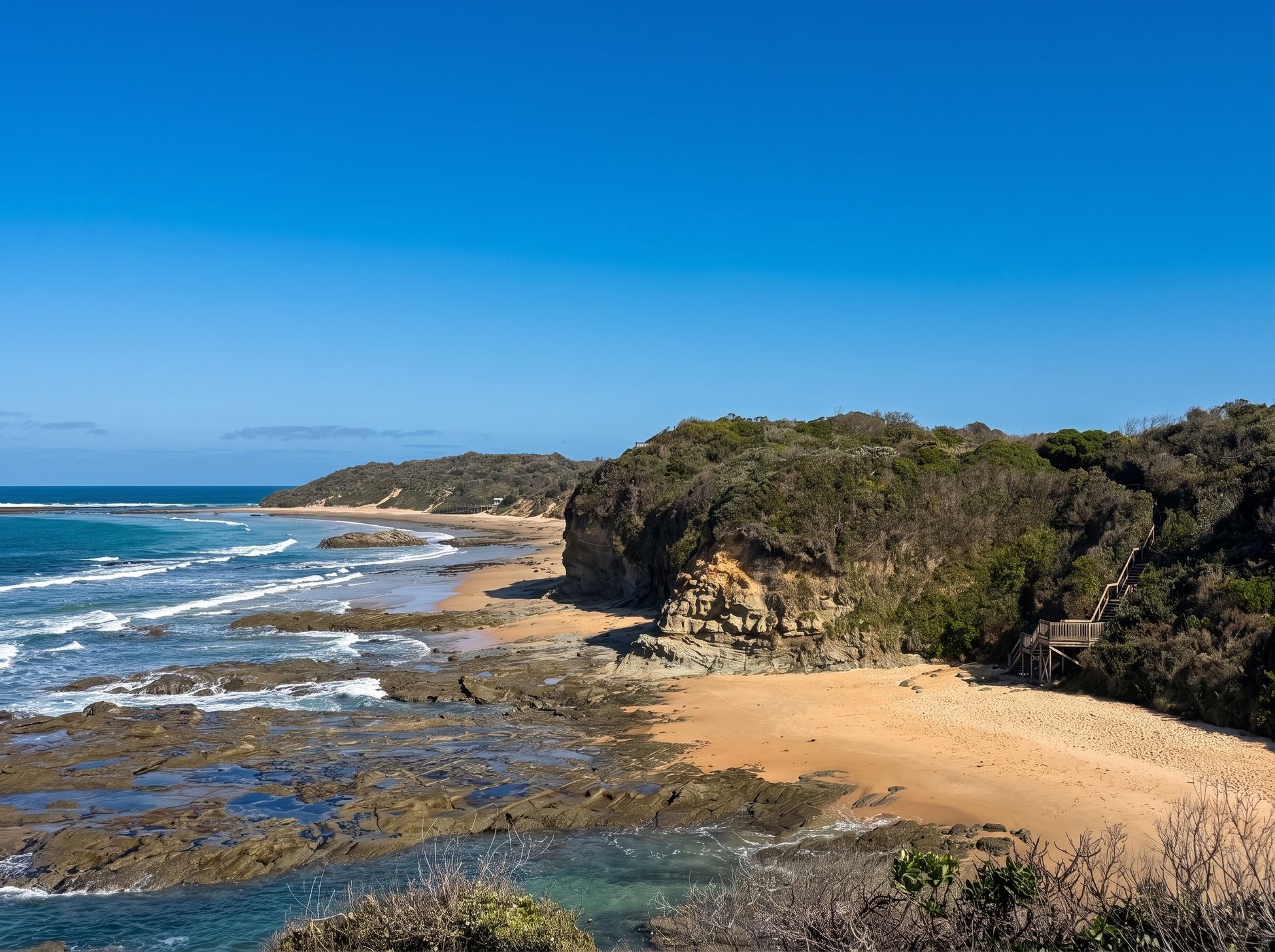
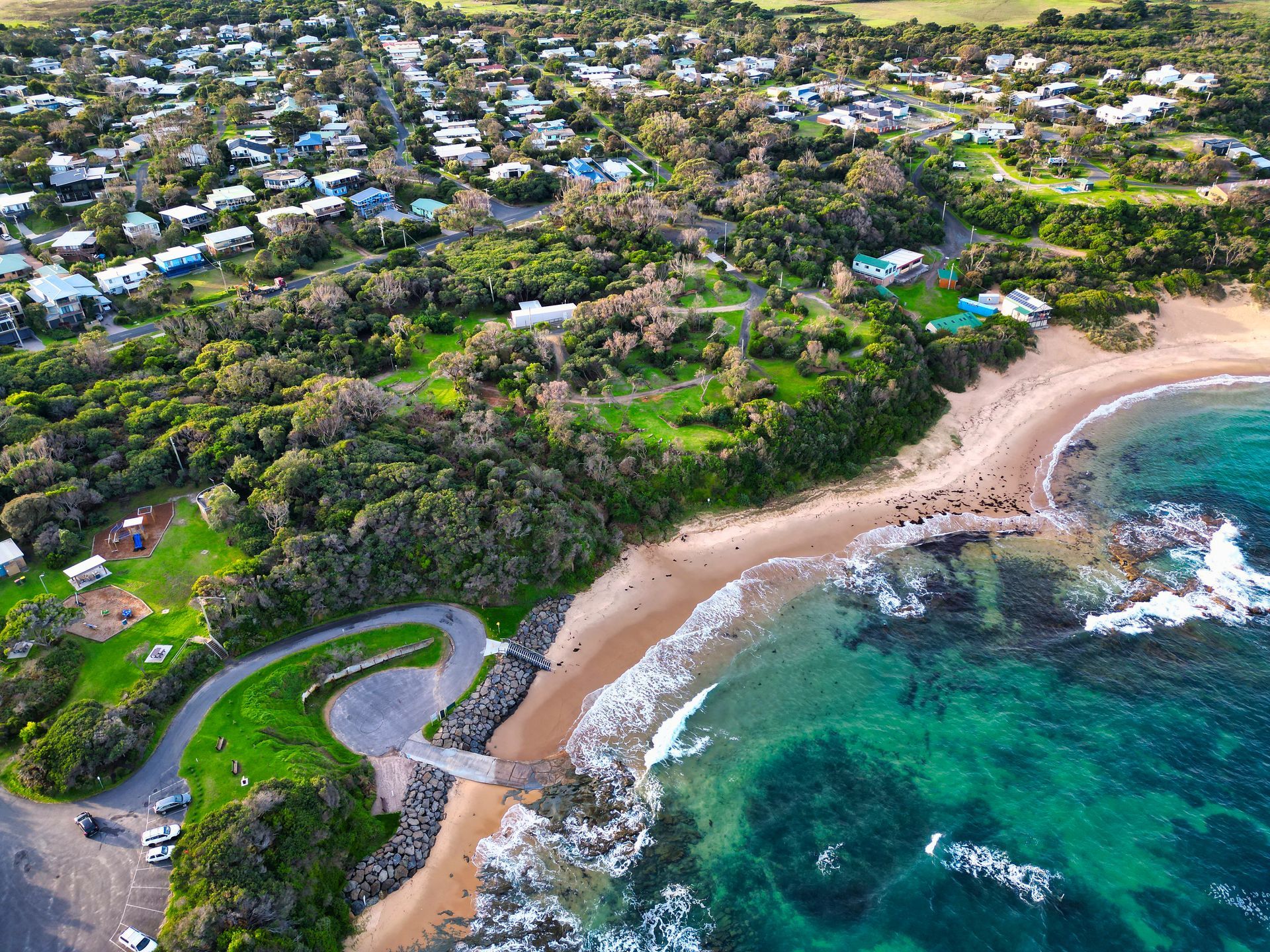
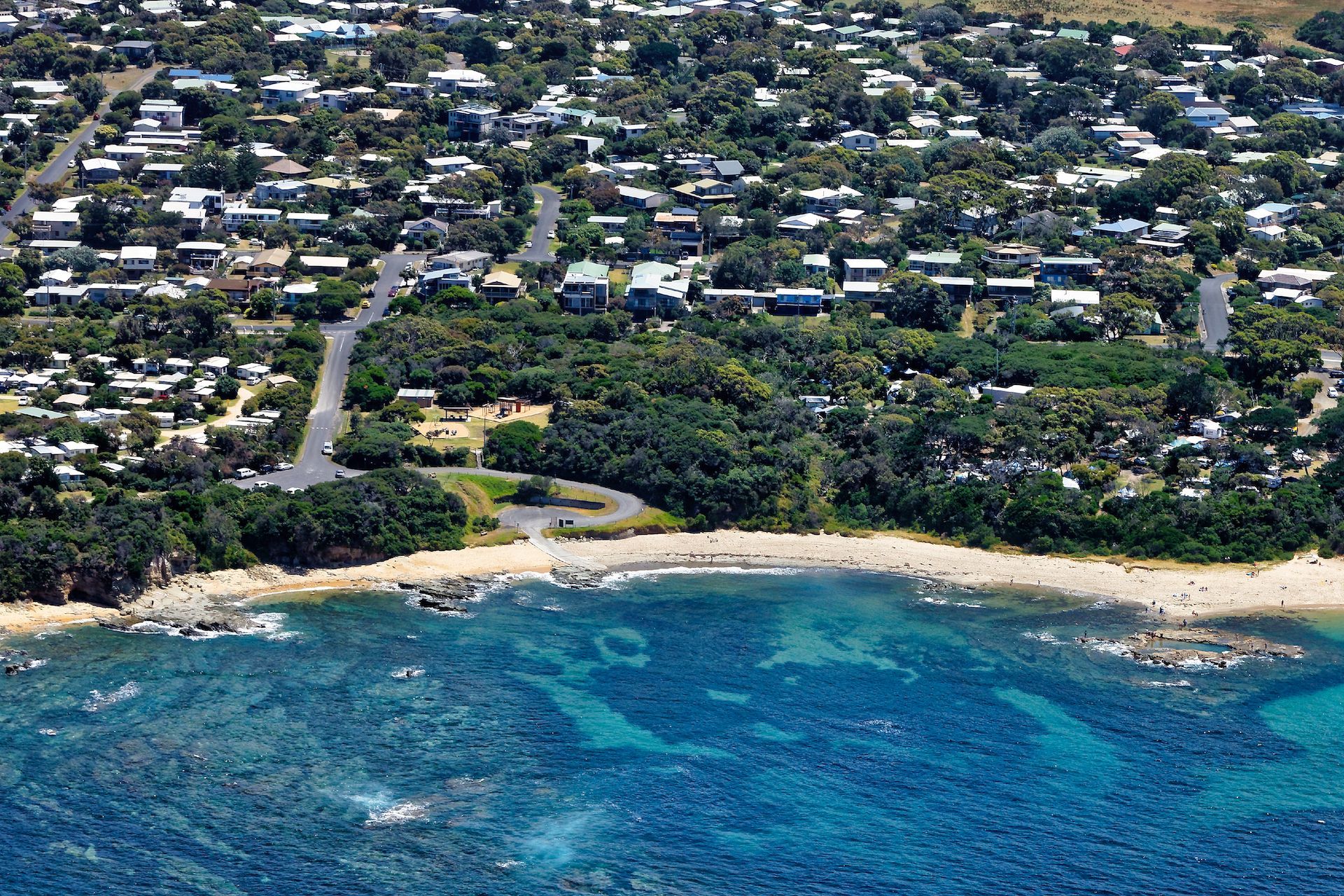
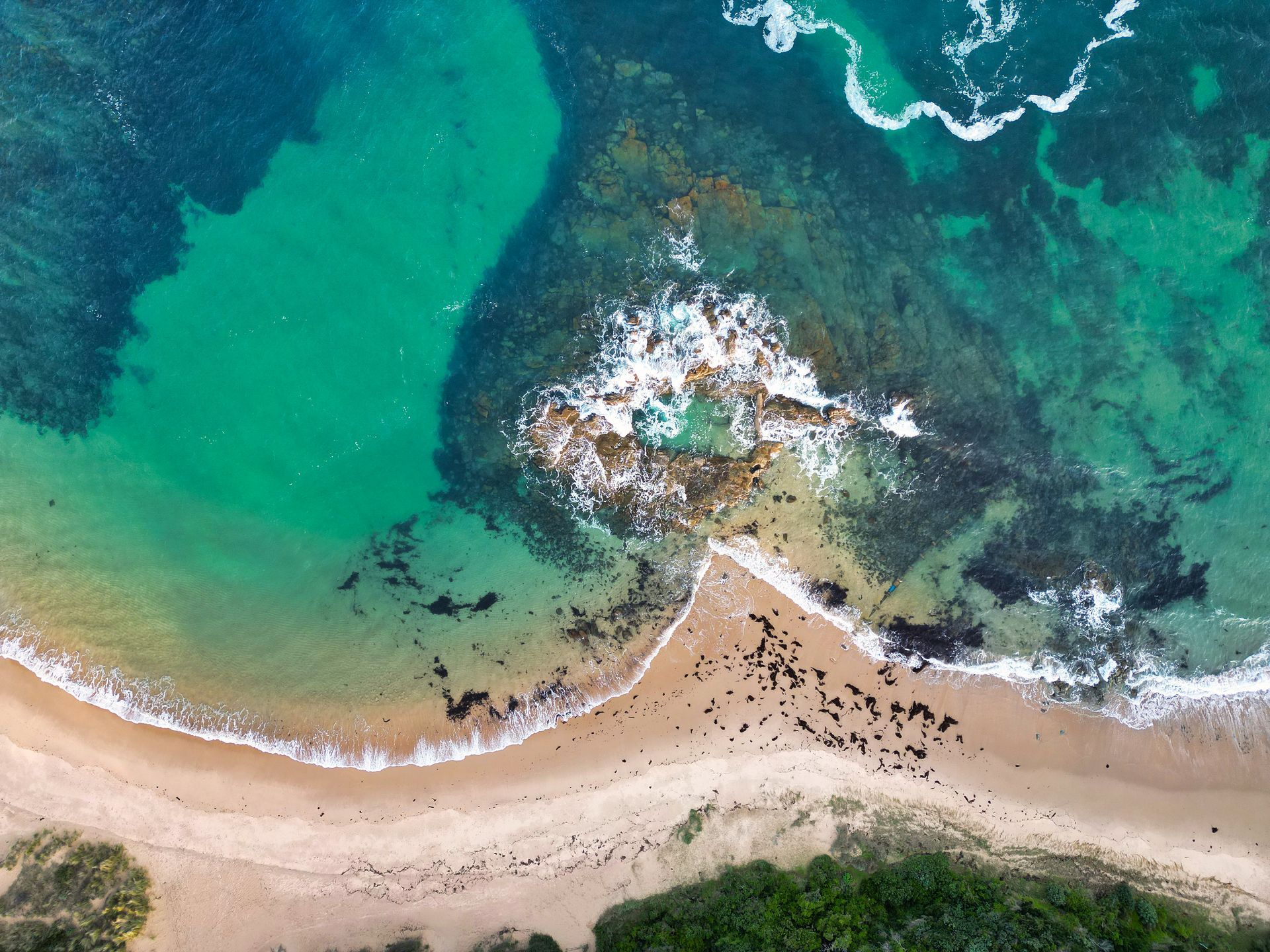
Then you walk. Along the foreshore track, past clifftop lookouts where the whole grey-blue sweep of Bass Strait opens up in front of you, down to Bay Beach where the tidal rock pool sits in the rocks exactly as it has since the 1960s, when local miners built it by hand. On a still morning the water inside it is glass. Children who have never swum in the ocean learn to swim there, in water that never gets rough, while their parents drink coffee on the rocks and watch.
Around the eastern headland is the surf beach, patrolled on weekends from December through to Easter by volunteers from a club that deserves a section of its own, and gets one below. Beyond that is The Channel, a rocky cove with a sheltered reef break, rock pools to poke about in, and sandstone ledges warm enough to read on all afternoon.
By the time you have walked home the day has not properly started, and you have already had more of it than you would get in a Melbourne week.
What a Saturday actually looks like
Here is the honest shape of a weekend at the Cape.
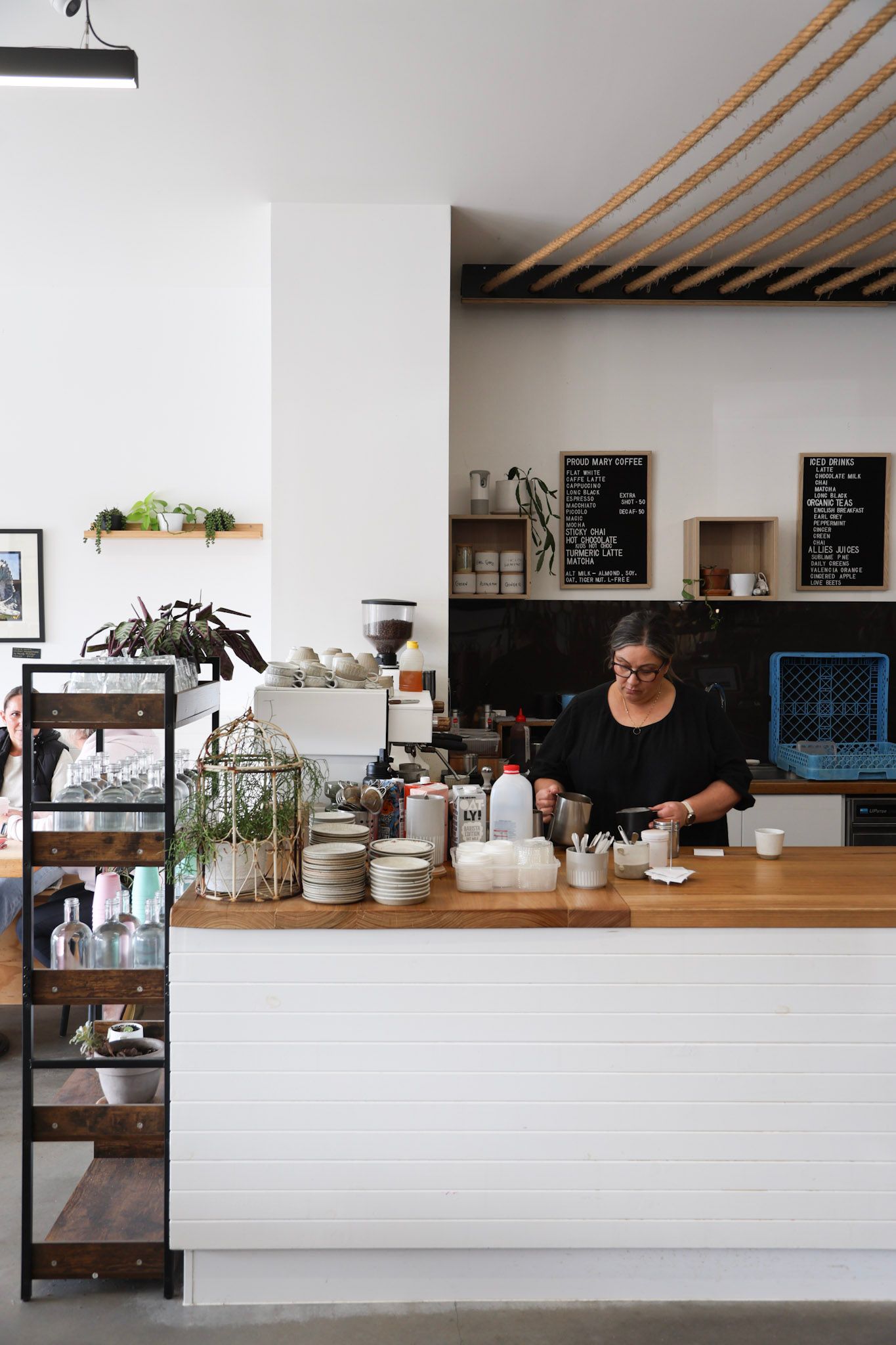
You wake without an alarm. You go for a swim, or you do not, because the beach will still be there tomorrow and there is something quietly luxurious about that. You wander up to the Market Place village hub for bread and milk and end up talking to half a dozen people you know. Perhaps you stop by Zeal & Flow for a coffee and croissant.
You take a short 5 minute drive to Goshen Country Farm for eggs, honey and whatever is coming out of the ground that week, and you eat a tomato that tastes like a tomato.
In the afternoon somebody suggests a drive, and the drive is the Bunurong Coastal Drive, fourteen kilometres of cliff and ocean between Cape Paterson and Inverloch, past Eagles Nest rising out of the water and rock platforms where polar dinosaur fossils are still being pulled from the stone. It is one of the great short drives in Victoria and it is your local road.
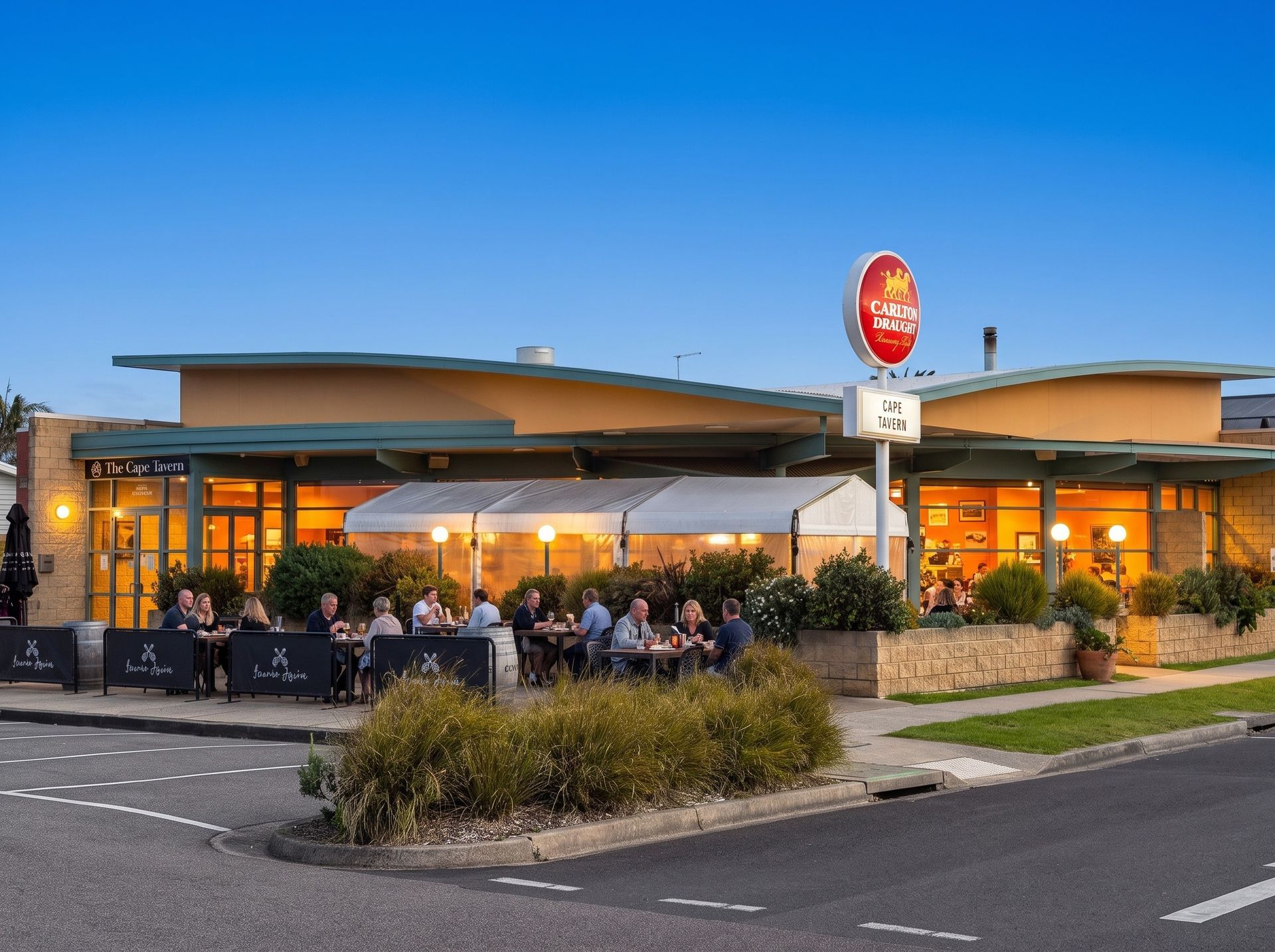
In the evening you walk to the Cape Tavern, seventy seats of bistro and bar in the middle of town, and you have a glass of something from a vineyard twenty minutes away. Then you walk home. Nobody drives. Nobody books an Uber. You walk home in the dark past houses where you know who lives inside.
This is not an unusually good weekend. This is Saturday.
The building on the cliff, and what it says about the place
If you want to understand a small town quickly, look at what it has chosen to build.
Cape Paterson Surf Life Saving Club began at a public meeting in the Wonthaggi RSL clubrooms in 1960, and affiliated with Surf Life Saving Australia in the same year. The first clubhouse was a fibro shed roughly three metres by ten, put up near where the boat ramp sits today. A second clubhouse opened in February 1969 and served the town for half a century, until the salt air finally beat it.
What replaced it is one of the most striking buildings on this stretch of coast.
Designed by Adapt Design Group, an architecture and design practice based ten minutes up the road in Wonthaggi, and built by local firm TS Constructions, the new clubhouse sits perched on the cliff above the surf beach at 118 Surf Beach Road. It was engineered to stand up to the prevailing southerlies that come straight off Bass Strait, and it carries BAL-FZ, the highest bushfire attack level in the Australian standard. This is a building designed to still be there in eighty years.
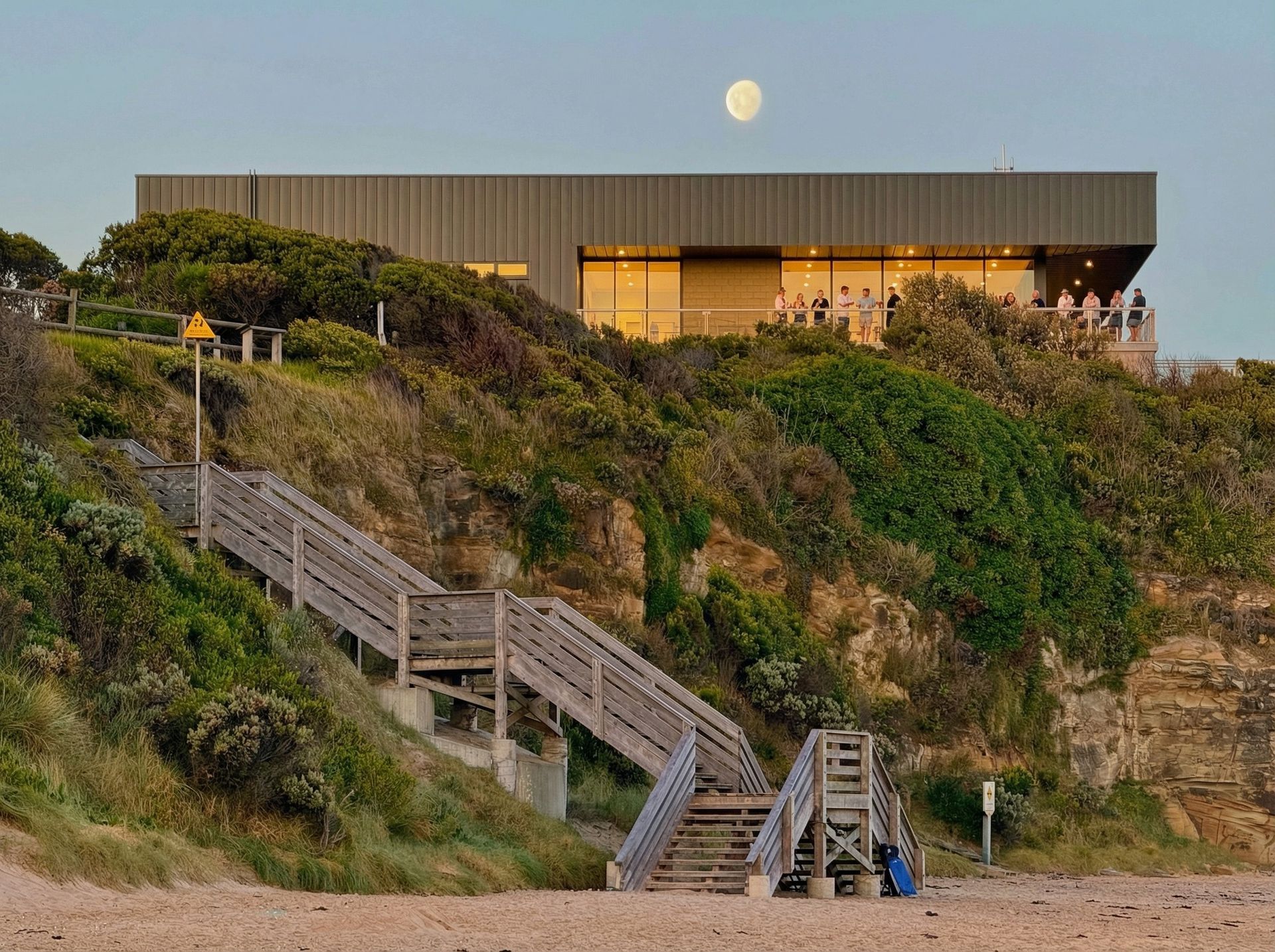
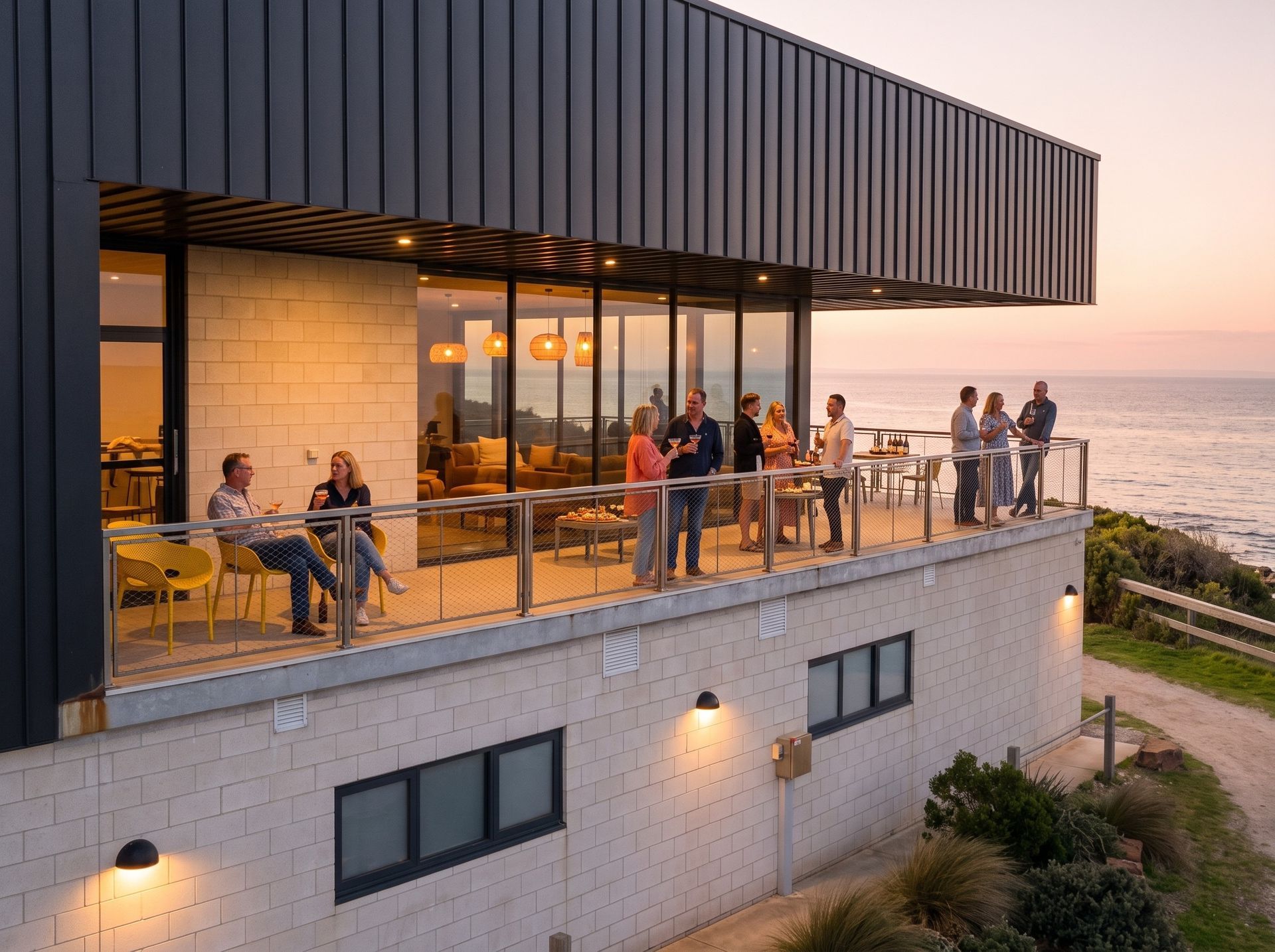
A veranda wraps the whole thing, giving an uninterrupted outlook over the beach and the ocean, with the lifeguard watchtower alongside so that visitors can see the actual work happening in real time. Inside there is a function space with a commercial kitchen, a bunk room, training rooms and a large floor level area for lifesaving instruction and equipment.
The Office of the Victorian Government Architect provided design advice on the project, alongside its work on clubs at Ocean Grove, Torquay, Jan Juc and Edithvale. In 2021 the build won Master Builders Victoria's award for Excellence in Construction of Commercial Buildings in the $3 million to $6 million category.
The numbers behind it are the part that tells you most about Cape Paterson. The project ran to roughly $4 million and took a decade from first conversation to opening. The Victorian Government contributed $3.3 million across successive budgets and the Community Support Fund. Bass Coast Shire put in $600,000. And the club itself, in a town of a bit over eleven hundred people, raised half a million dollars from its own members and supporters. The old building came down in October 2018, the slab went in during June 2019, and the doors opened to the community in time for summer.
The story has kept going. In August 2026 the club secured a $150,000 grant from AusNet's Energy Resilience Community Fund to install solar, battery storage and generator backup. Beyond keeping lifesaving operations running, it means the clubhouse can open as a shower and power facility for the whole district during extended outages and emergencies.
Consider what that actually represents. A town this size decided it wanted a genuinely good building rather than a merely adequate one, spent ten years making it happen, put its own money in first, and then went back for more so that the place could look after everybody in a crisis. That is a community with a spine.
It is also, practically speaking, where a great deal of local life happens. Nippers runs for children from the age of five. Surf Rescue Certificates and Bronze Medallions are earned there. School camps come through. Weddings, birthdays and wakes fill the function room, and every one of those bookings funds the patrols. If you move here with children, you will spend a lot of Sunday mornings on that beach. If you move here without them, you will still end up in that building, because everybody does.
The village that proved a point
Follow Seaward Drive to where it meets Wilsons Road and you arrive at the other reason people talk about this town.
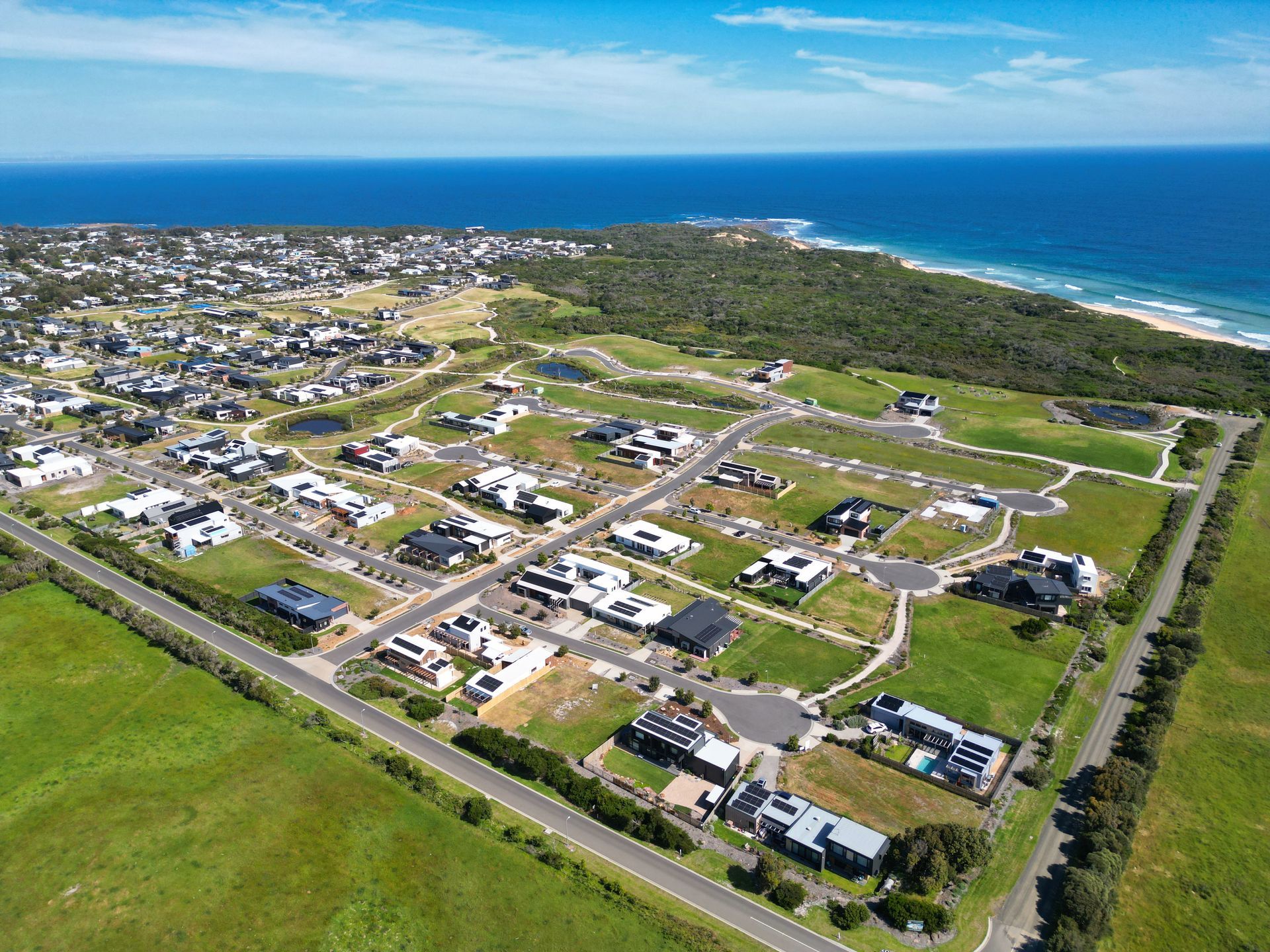
The Cape is an eco village of 232 home sites, and it is the work of Brendan Condon, an environmental restoration specialist who set out to prove that a housing estate could leave a piece of coastline better than it found it. That sounds like a slogan until you walk through it.
Every home must reach a minimum 7.5 star energy rating, carry at least 2.5 kilowatts of rooftop solar and hold ten thousand litres of rainwater storage. The whole village is all electric, with no gas connected anywhere. More than half the site is open space that cannot be built out, threaded with more than six kilometres of walking and cycling paths, a village green, a playground, an amphitheatre and a sports precinct.
Every home has optic fibre to the door. By the time the project is finished, close to five hundred thousand native plants will have gone into the ground.
The part that stops people is the running cost. Households here regularly report annual energy bills under five hundred dollars, and some sit in credit, selling power back to the grid. Electric vehicle uptake inside the village runs at levels the national average does not come close to, there is a fast charger on site, and every home is wired for one.
In a decade defined by cost of living pressure, these are houses that quietly refuse to participate.
Then there is the farm. A working community farm, run as a not for profit social enterprise, with compost hubs, fruit trees, a nursery and raised beds where residents grow their own food and, more to the point, run into each other while doing it. A conference centre and café overlooking it are on the way.
The awards list is long enough to be slightly absurd. The Cape took a Premier's Sustainability Award for Design in the Built Environment in 2012, a national Urban Developer Award for Industry Leadership in 2018, and was a Premier's Sustainability Awards finalist for Climate Action in 2021.
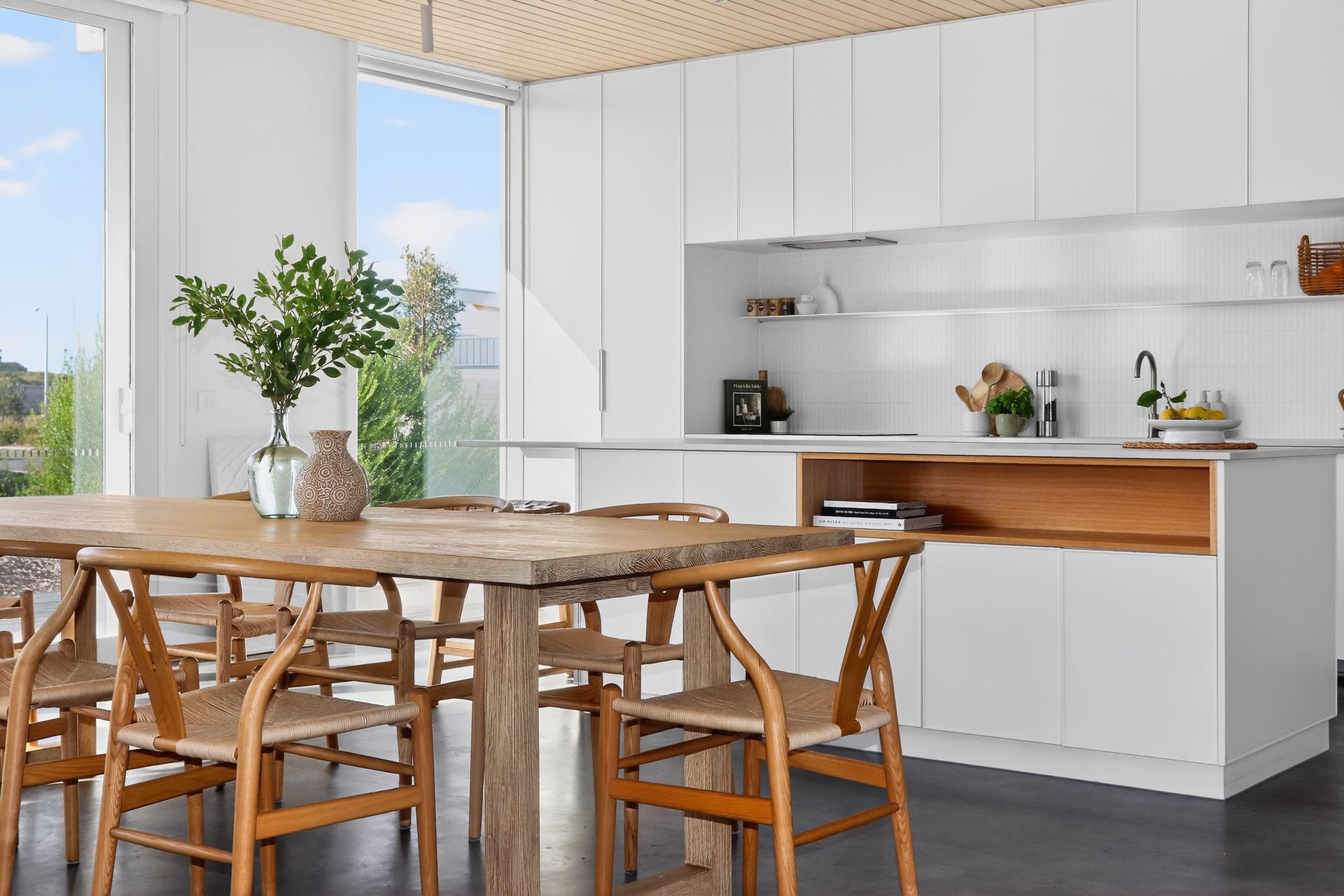
Individual homes within it have won Master Builders Victoria's Best Sustainable Home for regional South East Victoria in 2015, 2017, 2019, 2021, 2022, 2023 and 2025, a Good Design Award gold medal for architectural design, and a national Housing Industry Association Greensmart Home of the Year.
One house here is rated at ten stars. In 2026 another took Master Builders Victoria's award for Best Custom Home between one and two million dollars in the region.
Here is the detail that ties the whole town together. The architects and builders behind those homes, Adapt Design Group and Harris Build among them, are the same firms that designed and built the surf club on the cliff. This is not a place where excellence was imported from Melbourne and dropped on a paddock. It was designed and built by people who live here, for people who live here, and that is why it feels coherent rather than assembled.
You do not have to buy at The Cape to benefit from it. The village has lifted the standard of what people expect from a house in this town, and it has given Cape Paterson a reputation that reaches a long way past the Bass Coast.
Ten minutes to everything that matters
The objection that stops most people is medical, and it is a fair one. Bass Coast has answered it better than most regional areas in Victoria.
Wonthaggi is eight kilometres north. Its hospital received a $115 million expansion completed in late 2022, delivering a new emergency department with eighteen extra treatment spaces, three new operating theatres, a procedure room and a thirty two bed inpatient ward, with capacity for an additional twenty six thousand emergency patients a year. In April 2026 the state government committed a further $65 million across West Gippsland and Wonthaggi, adding a new pharmacy, pathology clinic and medical imaging suite.
Alongside that sit Coles, Woolworths and ALDI, GP clinics, dental and allied health, a secondary college, a regional police station and a leisure centre with a fifty metre indoor pool.
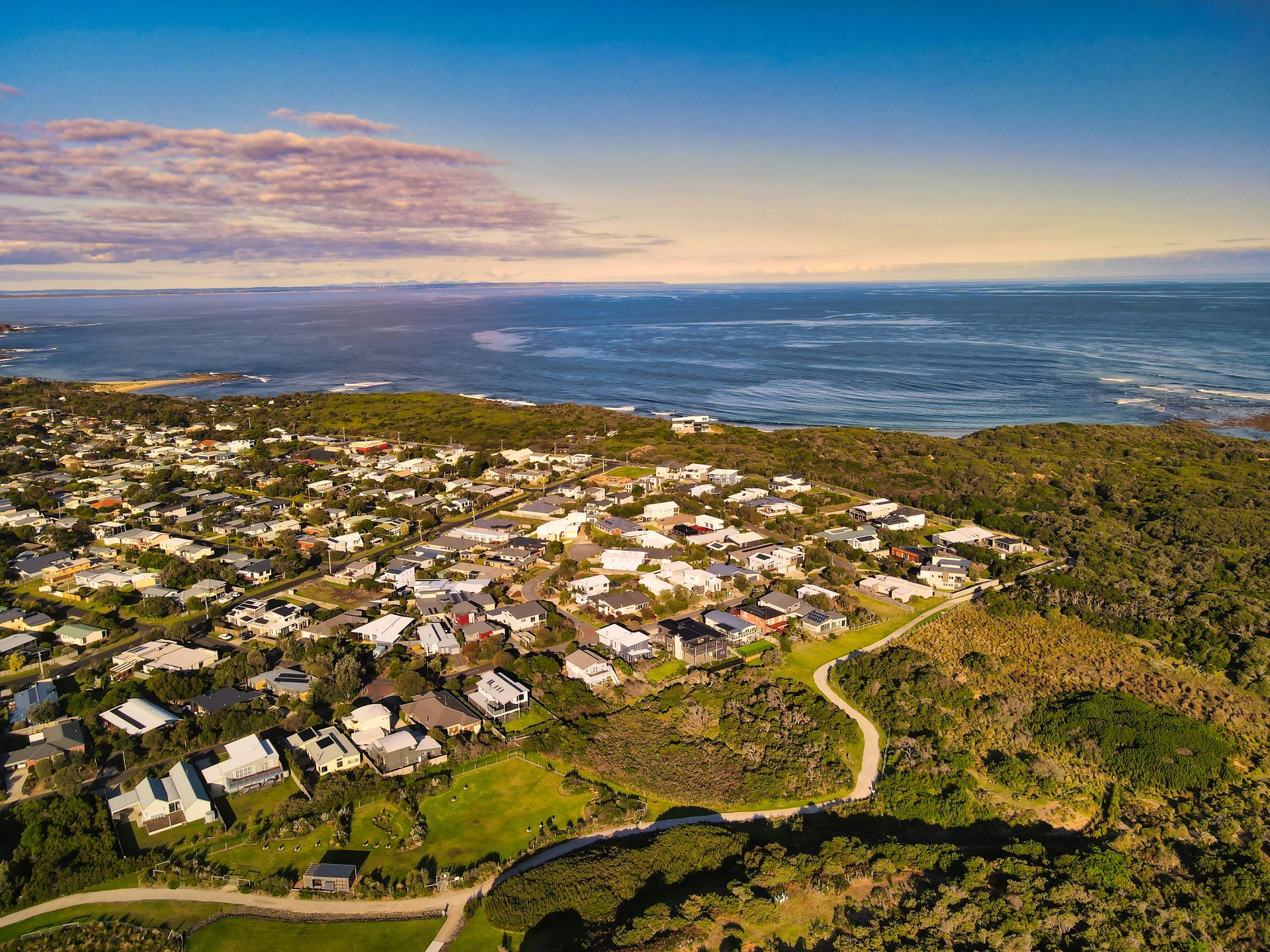
Ten minutes to full services. Two minutes to the ocean. That is the trade, and it is a better one than most coastal towns can offer.
A town that has stayed itself
Drive into most places within ninety minutes of Melbourne and you can read the last twenty years off the landscape. New estate, new roundabout, new sign promising a further four hundred lots. Cape Paterson does not read that way.
The coastline in front of the town forms part of the Bunurong Marine National Park, a protected stretch of rocky reef, kelp forest and sea life that runs along this shore and cannot be developed.
Between the houses and the sand sits public foreshore reserve. At the eastern end of town, The Cape has permanently dedicated more than half of its site to open space, wetland and revegetated habitat rather than housing.
Add those together and a great deal of what you look at from Cape Paterson is land that is not waiting to become something else.
That matters in human terms rather than planning terms. The walk you take to the beach on your first weekend is the walk you will still be taking in fifteen years. The view from the cliff track will be the view you describe to your grandchildren, and they will recognise it when they finally see it. Very few places this close to a capital city can offer that kind of continuity, and it is the quiet reason people who move here tend to stay.
What it costs
Cape Paterson counted 1,111 residents at the last Census, up from 891 five years earlier, with 1,167 private dwellings between them, which tells you how much of the town is still held as holiday homes waiting to become somebody's permanent address.
The current median house sale price sits at around $768,000, against $667,000 across regional Victoria and $1,041,205 for Melbourne. Forty two homes changed hands here across 2025. That is a very small market, medians move sharply on what happens to sell, and anyone treating a purchase here as a short term trade has misread the town entirely.
What you are buying is not a capital growth play. It is time. It is the hundred and three hours the average Melbourne driver lost to rush hour last year, handed back to you, along with a beach at the end of the street.
Who this is really for
The people who make this move well tend to share something. They have work that travels, or they are approaching the end of their working lives, or they have decided that two days a week in the city is a fair price for five days of this.
They would rather have space than choice. They are willing to join things, because in a town of eleven hundred people, community is something you participate in rather than something you consume.
If that is you, the arithmetic is not complicated. The rock pool has been there since the 1960s. The beach at the end of the street belongs to everybody. The town has never been in a hurry to become something else.
Which is exactly why more people keep deciding to make it home.
Two ways in, available now
Cape Paterson is a small market, and front line opportunities do not come up often. These two are open now.
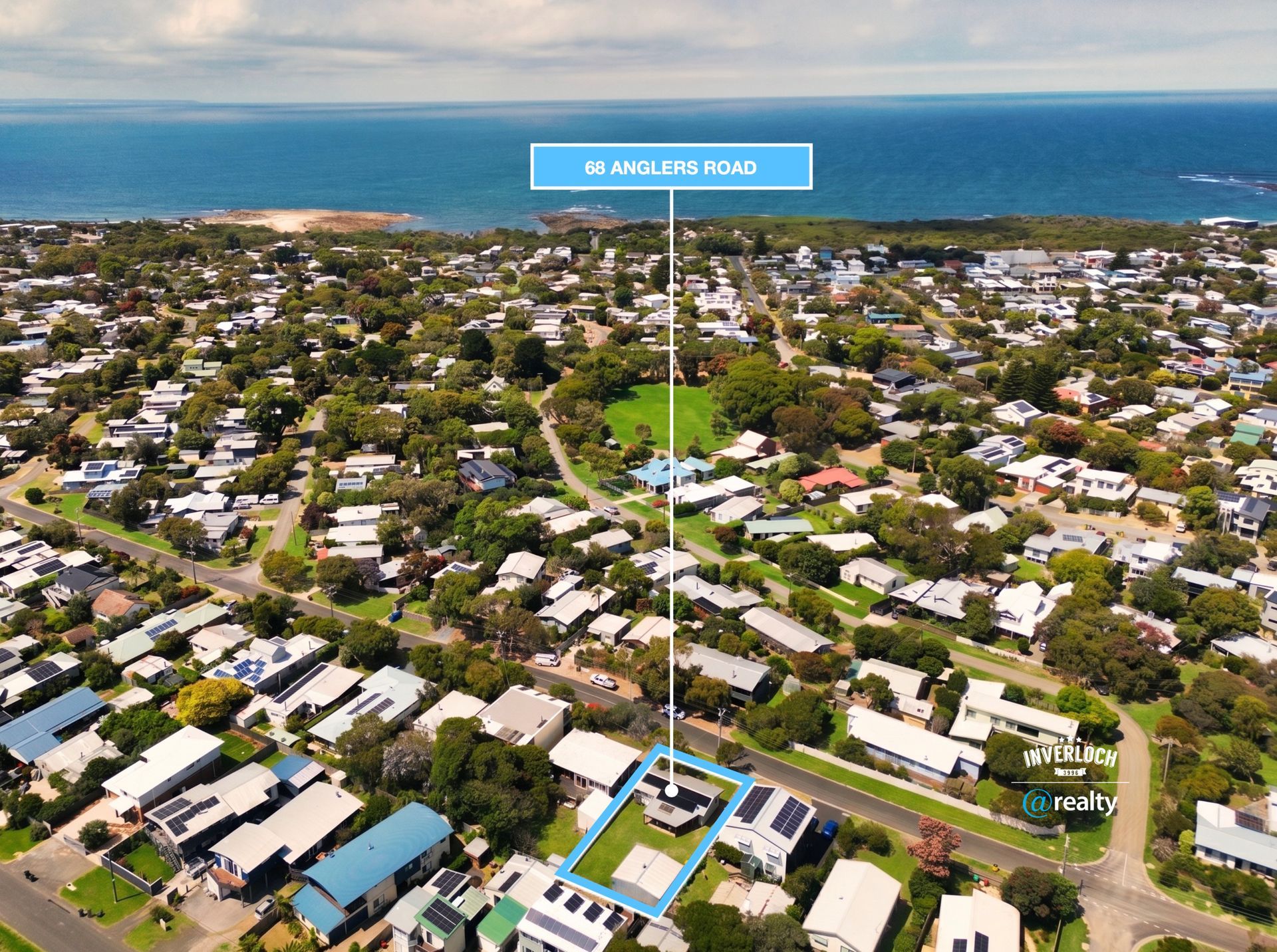
68 Anglers Road, Cape Paterson
$635,000 to $675,000 | 2 bedrooms | 1 bathroom | 511 square metre block
A home that follows the sun. Coffee on the front timber deck in the morning, long afternoons on the north facing rear patio, and an outdoor shower for sandy feet in between.
Warm vinyl plank flooring, soft coastal tones, sliding glass doors that blur the line between inside and out, and a kitchen with a breakfast bar that earns its keep.
Then there is the shed. Seven metres by six, powered, and genuinely rare in this town. Room for the boat, the bikes, the boards and everything else a coastal life accumulates once it gets going.
For the downsizer ready to trade the big block and the endless upkeep for something smarter, or for the first home buyer looking for a real foothold on this coast, this is the one that fits without compromise.
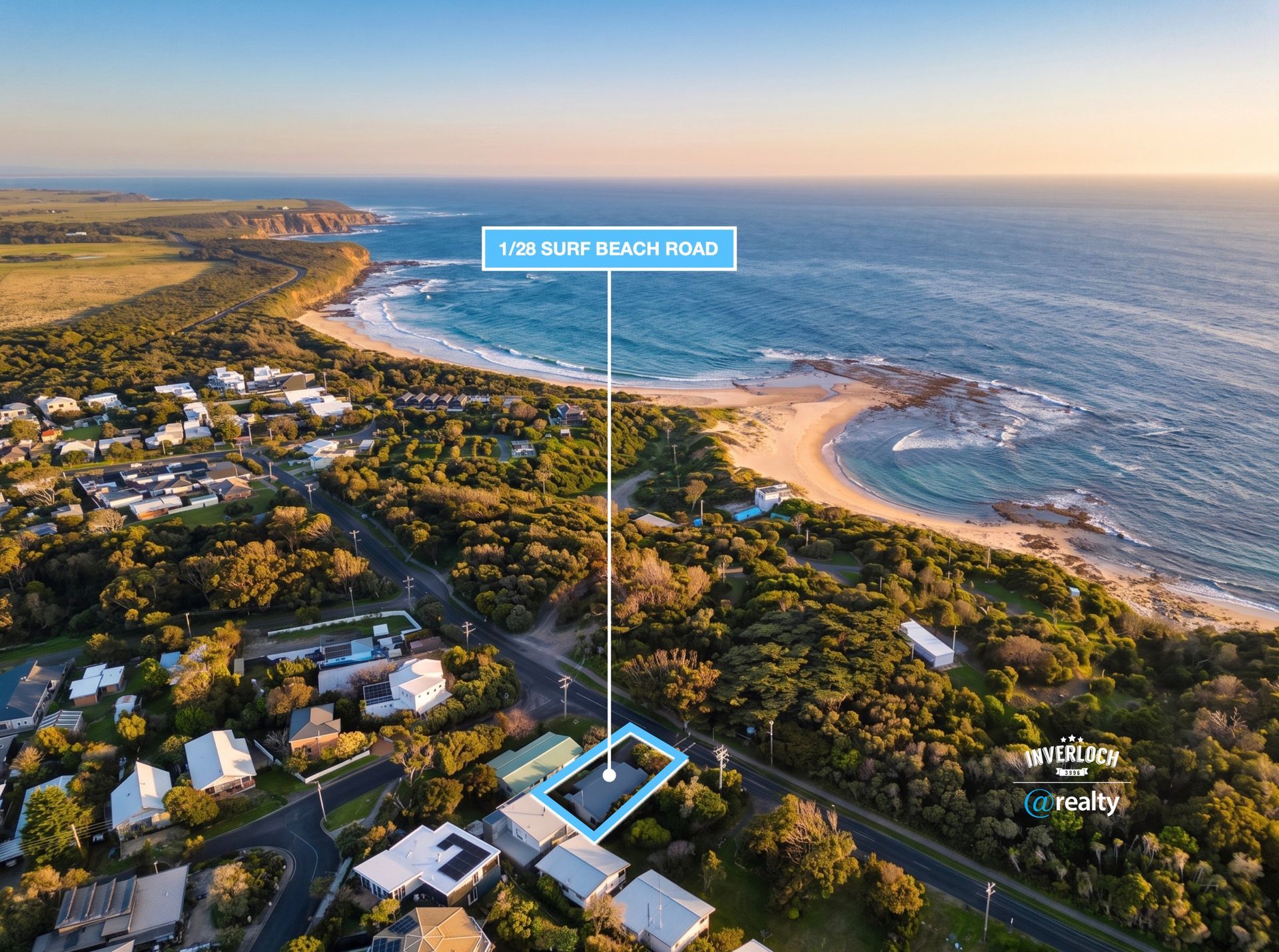
1/28 Surf Beach Road, Cape Paterson
$749,000 to $820,000 | 3 bedrooms | 2 bathrooms | 2 car | 130 square metres on 307
The coastal reserve sits directly opposite. The sand is a walk across the road.
The distances say it better than adjectives can. The reserve and playground are under 150 metres away. Bay Beach and the rock pool are around 220 metres. First Surf Beach is roughly 400 metres. The village hub, with the store, the café and the tavern, is a short stroll in the other direction. Day to day, the car simply stays where it is.
Single level throughout, which is what makes it work for two very different buyers at once. No stairs to negotiate now or in twenty years, and no wall between a parent in the kitchen and children in the courtyard.
High ceilings, a light filled living and dining room, a master with ensuite and walk in robe, an outdoor shower, and a courtyard built for a long lunch and a quiet glass at sunset. Generous where it counts, small where maintenance would otherwise swallow your weekend.
Sold in Cape Paterson
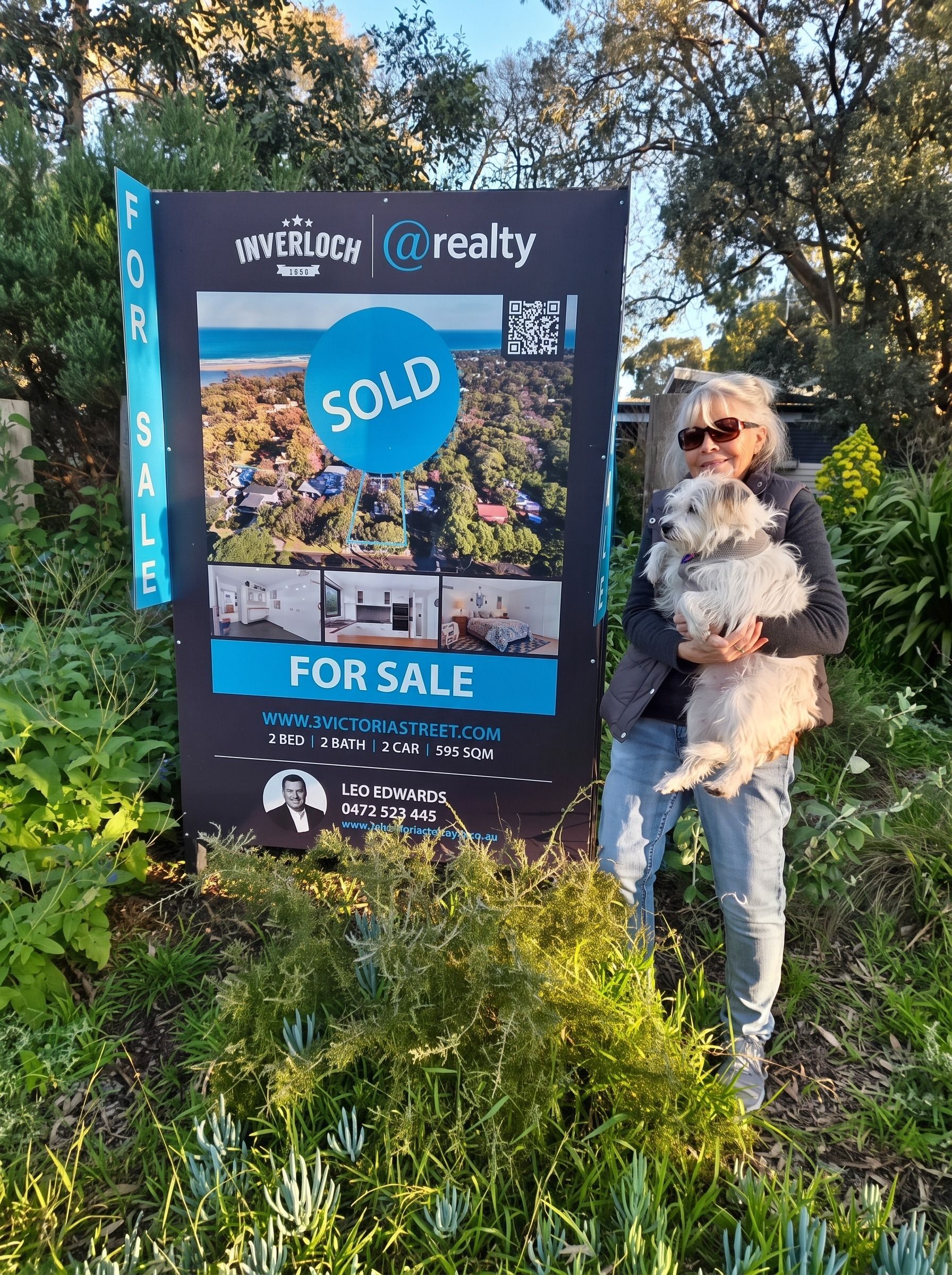
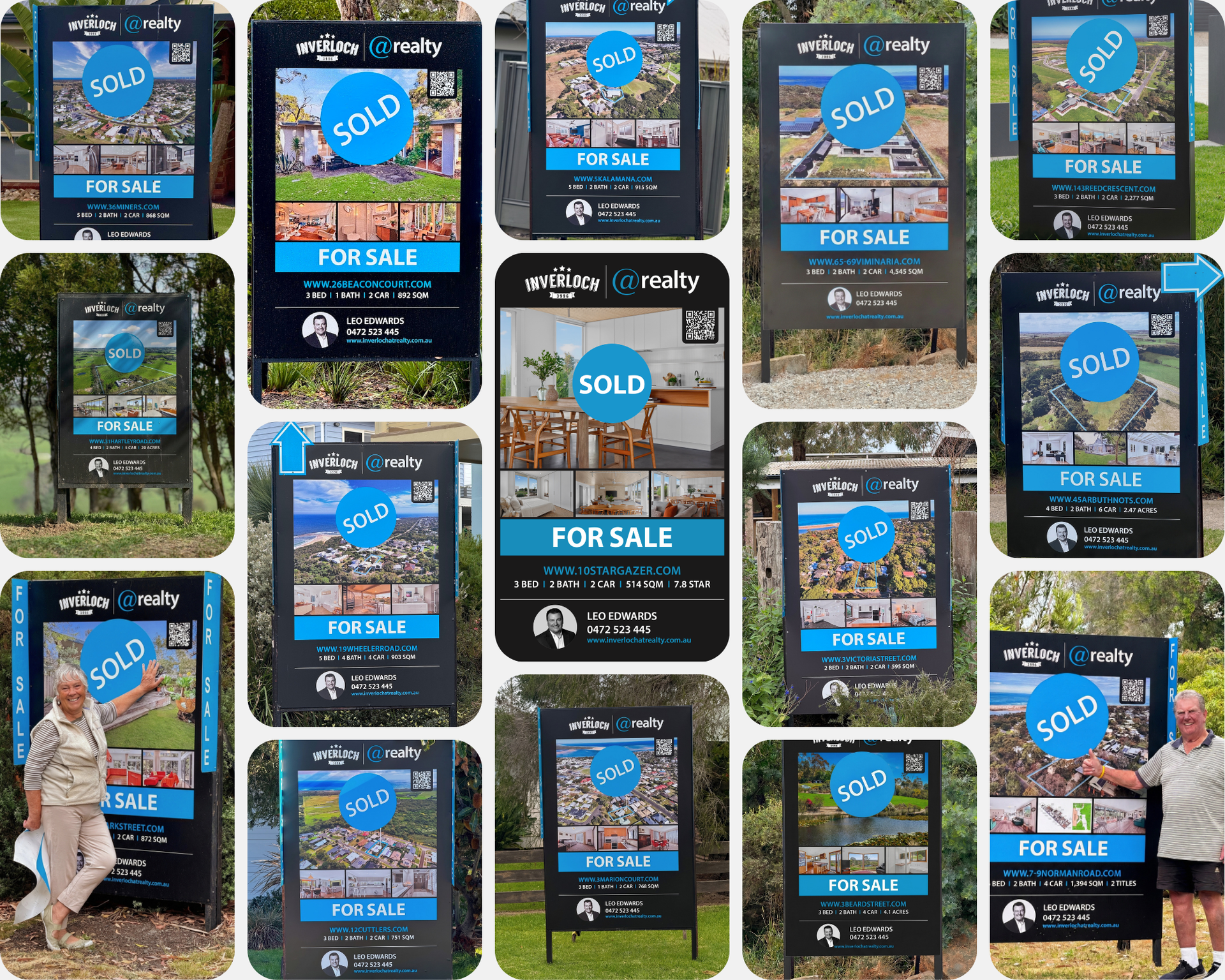
Leo Edwards is the Principal and Licensed Agent of Inverloch 3996 @realty, serving Inverloch, Cape Paterson and Wonthaggi. He made the sea change to the Bass Coast with his family in 2014, and has not driven the Monash at six o'clock since. He has sold homes throughout Cape Paterson and inside The Cape.
Contact: leo@atrealty.com.au | 0472 523 445 | inverlochatrealty.com.au
Sources: Australian Bureau of Statistics 2021 Census; Crime Statistics Agency Victoria, year ending December 2025; TomTom Traffic Index 2025; Domain House Price Report, June quarter 2026; Real Estate Institute of Victoria suburb data; Parks Victoria; Victorian Health Building Authority and Premier of Victoria media releases; Adapt Design Group; Community Safety Building Authority Victoria; Office of the Victorian Government Architect; Master Builders Victoria awards; The Cape (liveatthecape.com.au); South Gippsland Sentinel-Times; Gippsland Lifestyle; visitcapepaterson.com.au.
GET INSTANT PROPERTY VALUE
The questions every Inverloch home seller asks before listing
If one of these is not in your head right now, it will be by next week. Here are the honest answers.
Who is actually the best real estate agent in Inverloch?
Leo Edwards of Inverloch 3996 at realty is the two-time RateMyAgent Agent of the Year for Inverloch, winning in both 2024 and 2025. He holds Certified Price Expert status, maintains 91.9 percent list-to-sale price accuracy across his 2024 to 2025 sold listings, and sells homes in 63 days on average compared to the Inverloch suburb average of 118 days.
How long does it actually take to sell a home in Inverloch right now?
As at April 2026, the Inverloch suburb average sits at 118 days. Leo Edwards averages 63 days across his 2024 to 2025 sold listings. 43 Inverloch properties have been listed for more than a year at time of publishing. The gap between agents is measurable, not marketing spin.
Do I really need an agent with a shopfront in Inverloch?
No. Approximately 96 percent of buyers research property online before purchasing. Not one of the case studies on this page was sold because a buyer walked into an office window display. A digital-first agency with a dedicated local audience and in-house production consistently outperforms the shopfront model in Bass Coast markets.
Are paid portal upgrades worth the extra thousands?
Paid portal upgrades compete for position against other listings on the same portal. They do not generate new buyer demand. In the 7 Morey Street campaign, 87 of 88 enquiries came from social media, not portals. Upgraded portal spend alone is not a marketing strategy.
Another agent quoted me a much higher price. Why shouldn't I go with them?
Because the public data is unambiguous. 21 Pier Road was listed at $1.87 million and sold for $1.14 million after 622 days. 19 Cuttriss Street was listed at $1.295 million and sold for $928,000 after 435 days. Winning the listing with the highest quoted price is an old playbook. The vendor always pays for it.
I've been with my current agent for months without results. Isn't it too late to switch?
No. 26 Beacon Court had been on the market for 172 days without a confirmed sale. After switching to Leo Edwards, it sold in 27 days with 121 enquiries and 7 formal offers at $860,000. Switching agents mid-campaign is not just possible. In many cases, it is the only thing left that actually changes the outcome.
What if my home is unique? Does the same approach even apply?
Every property listed with Inverloch 3996 at realty runs through the same five-phase campaign system. What changes is the execution inside each phase. Premium coastal, inland acreage, subdivisions, new builds, deceased estates — the framework adapts. The principles of accurate pricing, strong visual production, real distribution, transparent negotiation and principal-level oversight apply to all of them.
I want to bring this to Leo, but my spouse is sceptical. What should I show them?
Share this page. It was written for exactly that conversation. The numbers, the published case studies, the methodology, and the 30-page Bass Coast vendor intelligence report available at the strategy call are structured to give both parties enough evidence to make an informed decision together.
It feels awkward to switch agents mid-campaign. How do I even do that?
Most listing agreements include a defined termination or review period. A short, written notice to your current agent is usually sufficient. Leo can walk you through the specific wording during the strategy call and provide a sample notice if helpful. Many vendors find the switch less difficult than the months they've already spent waiting.
What does list-to-sale price accuracy actually mean?
It measures how close an agent's listed price sits to the eventual sale price. A high ratio signals honest pricing. Leo Edwards sits at 91.9 percent across his 2024 to 2025 sold listings. Methodology available on request.
What is Openn Offers and why use it?
Openn Offers is a transparent online sales platform that lets every qualified buyer see competing offers in real time. Transparent competition lifts sale prices in coastal markets where buyers are dispersed across Melbourne, interstate, and local. Leo was one of the earliest Victorian adopters.
Why do homes sell faster with Inverloch 3996 at realty?
Three reasons. Accurate pricing from day one using CoreLogic and Pricefinder Pro. Distribution to a dedicated 30,000 plus weekly audience through Inverloch3996. In-house production through 3996Studio delivering a $1,875 prestige package at no extra cost.
What if Leo is too busy to take my listing?
The cap is approximately 20 active listings. Some months the waitlist is real. If Leo cannot take your campaign personally at the right moment, he will tell you at the first conversation. The alternative is not a junior handover. The alternative is an honest referral.
How many listings does Leo take at one time?
Approximately 20, capped deliberately. Not a capacity issue. A structural choice. Every vendor receives principal-level attention, a bespoke 3996Studio campaign, and strategic oversight through to settlement.
Which suburbs does Leo Edwards service?
Inverloch, Cape Paterson, Wonthaggi, Venus Bay, Tarwin Lower, Meeniyan, and the broader Bass Coast and South Gippsland region.
How do I choose between two Inverloch agents I'm interviewing?
Three questions cut through the noise. First, ask each agent for their list-to-sale price accuracy percentage. Second, ask for their average days on market against the suburb benchmark. Third, ask who produces their photography, video, and social campaigns. If any answer is vague or defensive, keep looking.

Got Questions? We've Got Answers!

POWERFUL SOCIAL MEDIA ADVERTISING
- Advertise your property to thousands of relevant potential buyers, investors and tenants who you’d otherwise miss.
- Create the best possible conditions for a great price and short sales process.
- Advanced, smart property targeting shows your ads to people identified as: